


Arena Sand Gauteng: Silica Sand vs Riversand for Horse Arenas
Updated: Sep 23
For decades in South Africa, "riversand" was the go-to choice for arena footing. It was readily available, relatively cheap, and simply what everyone used. However, equestrian sports have evolved significantly. We now demand more from our horses athletically—higher jumps, tighter turns, and more complex dressage movements. Just as saddle fitting and nutrition have become sciences, so has arena construction.
At Harrogate Equestrian, we often receive calls to fix arenas that riders describe as "riding on the beach." The culprit is almost always the same: deep, unstable riversand. Here’s why we advocate for silica sand as the superior, modern choice—backed by science.
The Problem with Riversand: "Riding in Quicksand"
The biggest issue with traditional riversand is the shape of the particles. Riversand particles are naturally eroded by water, making them round and smooth. Imagine trying to stack a pile of marbles. They slide off one another. When a horse lands a jump or pushes off for a canter stride on riversand, those round particles roll away from the hoof.
The "Deep" Factor: Because the particles roll, the surface offers no resistance. The horse’s hoof sinks deep into the footing to find stability.
Tendon Strain: This lack of stability forces the horse to work much harder to pull their leg out of the surface, putting immense strain on tendons and ligaments.
Inconsistency: Riversand is a dredged product. One truckload might be coarse, while the next could be full of silt. This leads to arenas that are dusty in summer and rock-hard mud pies in winter.
The Science of Grip: Why Cohesion Matters

It’s not just about a "firm" feeling vs. a "deep" feeling. There is genuine physics at play here. In engineering terms, we are talking about Shear Strength. According to extensive research, including the FEI Equine Surfaces White Paper, the ideal surface must minimize Shear Failure. This occurs when the footing is too loose (like deep riversand), causing the foot to slide excessively during propulsion or landing.
1. Cohesiveness Through "Micro-Interlocking"
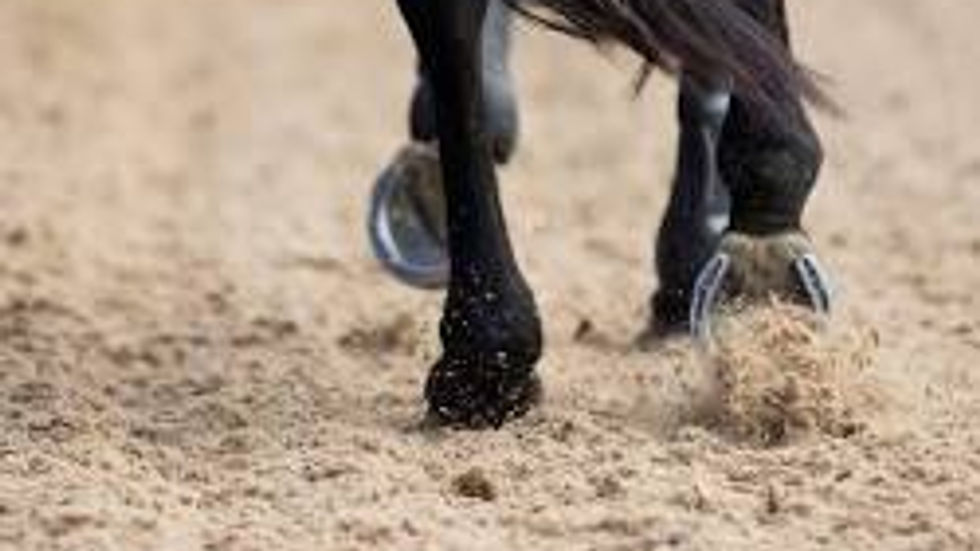
Research in the Journal of Equine Veterinary Science highlights that surface stability is largely determined by particle shape. Riversand is round; under the microscope, it resembles ball bearings. It has a low "angle of internal friction," meaning it tends to slide.
Our silica is sub-angular. When compacted, these jagged grains don’t just sit next to each other; they interlock. This creates a cohesive "mat" of sand. When a horse lands a 1.40m jump, the surface absorbs the energy through this structure rather than displacing (flying away).
2. The Role of Moisture (Capillary Action)
You’ve likely noticed that dry riversand is loose, while wet riversand is heavy. Silica behaves differently. Due to the consistent grain size, water creates a bridge between particles (capillary tension). This moisture-binding capacity allows us to "tune" the grip. A properly watered silica arena provides what biomechanists call "high shear resistance." This means when the hind leg pushes off for a gallop or a piaffe, the hoof stays put. The energy goes into forward motion, not into digging a hole.
3. Preventing the Injury Slide
Veterinary studies often point to the toe-grab phase of the stride as a critical moment for injury. In deep, non-cohesive sand, the toe rotates too far into the ground (hyperextension of the fetlock). Because silica is cohesive, it supports the hoof immediately upon landing. It allows for a controlled amount of slide (to absorb shock) but then quickly "locks up" to provide a solid platform for the next stride. This significantly reduces the load on the Deep Digital Flexor Tendon (DDFT) and suspensory ligaments.
The Harrogate Verdict: Investing in Your Horse's Future
We believe that building an arena is an investment in your horse's soundness. While riversand might seem like the cost-effective option upfront, the veterinary bills for suspensory injuries and the frustration of a deep, heavy surface often cost far more in the long run.
We build strictly with high-grade silica because we know it provides the safety, consistency, and performance that modern riders—and their horses—deserve.
Upgrading Your Arena: What You Need to Know
If you are considering upgrading your current surface or building a new arena from scratch, it’s essential to understand the benefits of silica sand. Not only does it provide a safer environment for your horse, but it also enhances performance.
The investment in a high-quality surface can lead to better training outcomes and fewer injuries. This is crucial for both competitive and recreational riders.
Thinking of upgrading your current surface or building a new arena from scratch?
Contact Harrogate Equestrian today for a consultation. Let’s get you on the right footing.
Sean Rabitte Harrogate Equestrian 068 211 0412 www.harrogateequestrian.co.za


Comments